How a steam engine works
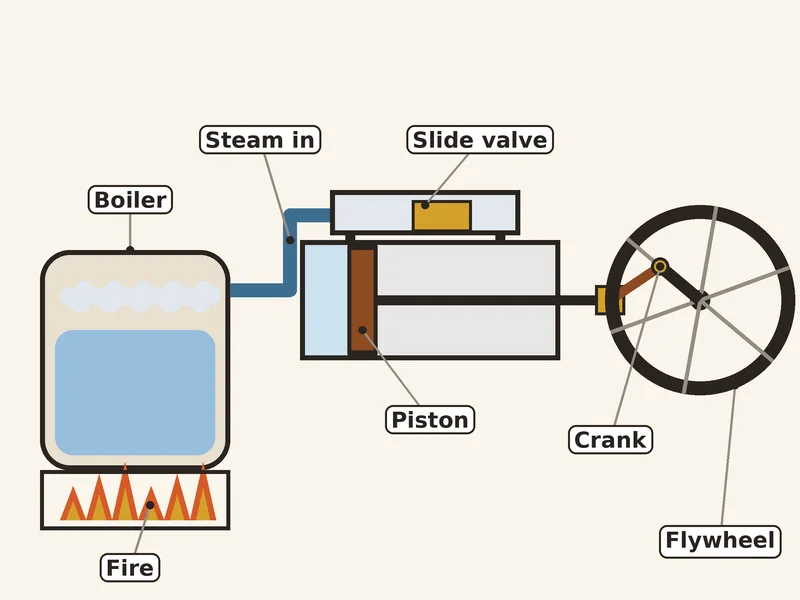
Heat makes steam, steam pushes a piston, a crank turns the push into a spin. The clever bits are in the details.
The big idea
A steam engine is a machine that uses steam to do mechanical work, with heat doing the pushing. Encyclopaedia Britannica: steam engine
Steam engines powered locomotives, steamboats, steamships and factory machines. Encyclopaedia Britannica: Industrial Revolution
Piston, crank and flywheel
In the classic engine the piston rod drives a crank on a flywheel, which turns the back-and-forth push into round-and-round motion. Encyclopaedia Britannica: steam engine
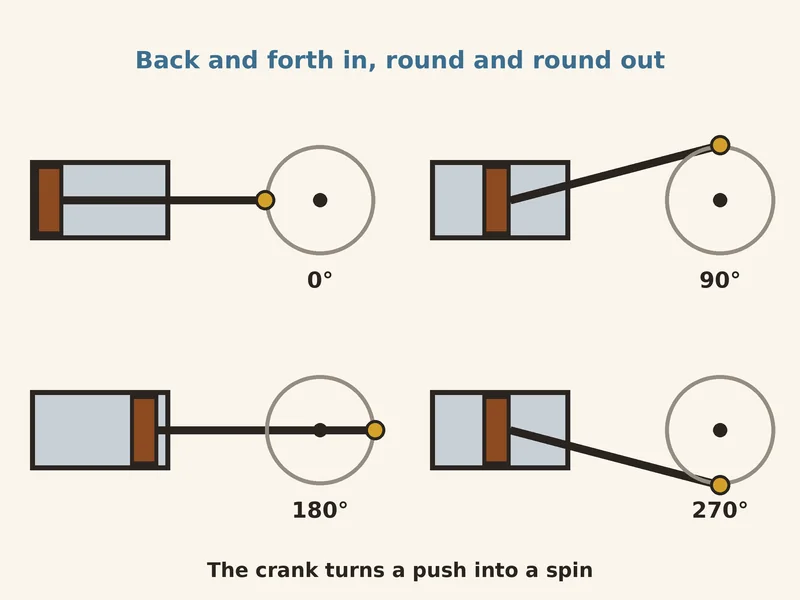
A flywheel’s inertia resists changes in speed, smoothing out the jerky pushes of the piston. Encyclopaedia Britannica: flywheel
Spin a flywheel twice as fast and it stores four times the energy. Encyclopaedia Britannica: flywheel
The slide valve and the double-acting engine
In a double-acting engine, steam from the boiler is let in to each side of the piston in turn, so it pushes both ways. Encyclopaedia Britannica: steam engine
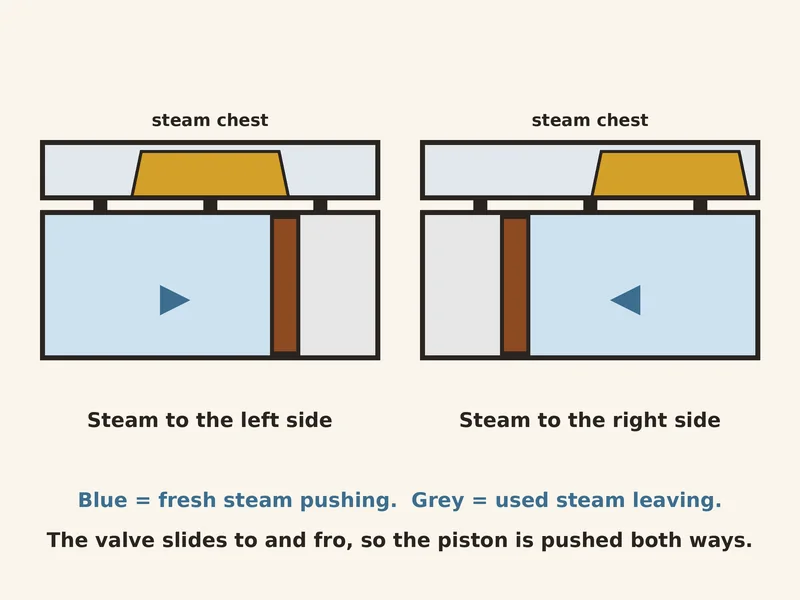
Want to see it move? The Steam Engine Explorer runs the whole cycle, and in Valve Master you get to be the valve.
Boilers
Boilers come in two big families: fire-tube boilers, where hot gas runs through tubes inside the water, and water-tube boilers, where the water runs through tubes inside the fire. Encyclopaedia Britannica: boiler
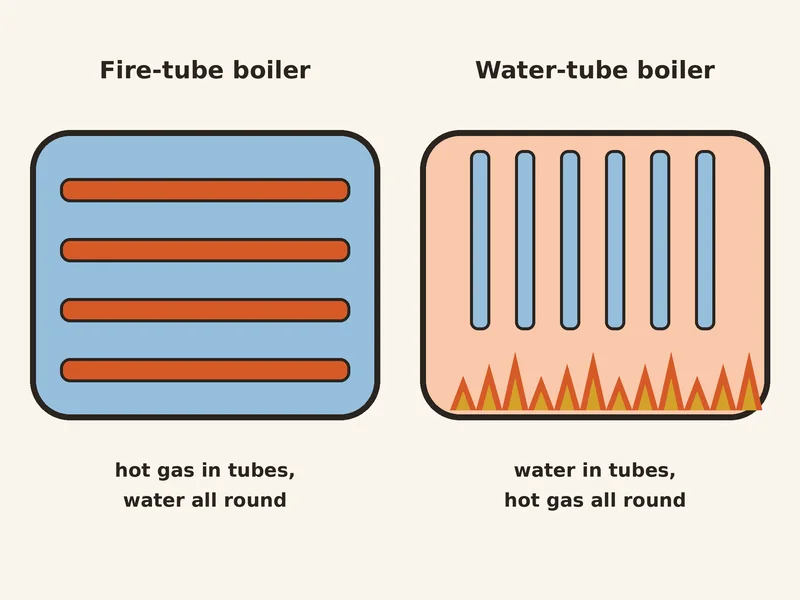
Water-tube boilers took over when power stations needed huge amounts of steam at pressures fire-tube boilers could not reach. Encyclopaedia Britannica: boiler
Why squeezed gas pushes back
Gas pressure comes from molecules in constant, random motion, banging into each other and into the walls. NASA Glenn Research Center: gas pressure
In the mid-1600s Robert Boyle studied how the pressure and volume of a trapped gas are linked. NASA Glenn Research Center: Boyle’s law Boyle found that pressure times volume stays nearly constant: halve the space and the pressure goes up to match. NASA Glenn Research Center: Boyle’s law
NASA’s worked example: a gas filling 4.0 cubic metres at 1.0 kilopascal shrinks to 3.0 cubic metres when the pressure rises to 1.33 kilopascals. NASA Glenn Research Center: Boyle’s law
Work, power and horsepower
Physicists define work as force times the distance something moves. NASA Glenn Research Center: work Work is measured in joules: one joule is one newton pushing through one metre. NASA Glenn Research Center: work
Power is how fast work gets done: the rate of change of work over time. NASA Glenn Research Center: work
One horsepower is 33,000 foot-pounds of work a minute. Encyclopaedia Britannica: horsepower James Watt fixed the horsepower after experiments with strong dray horses, and his figure is about 50 per cent more than an average horse can keep up. Encyclopaedia Britannica: horsepower
One horsepower is about 746 watts. Encyclopaedia Britannica: horsepower The watt, the unit of power, is named in honour of James Watt. Encyclopaedia Britannica: watt
No piston at all
In a steam turbine, the steam rushes out of nozzles at high speed and spins the blades directly, with no piston at all. Encyclopaedia Britannica: steam engine A steam turbine is a rotor sitting on bearings inside a cylindrical casing. Encyclopaedia Britannica: steam turbine
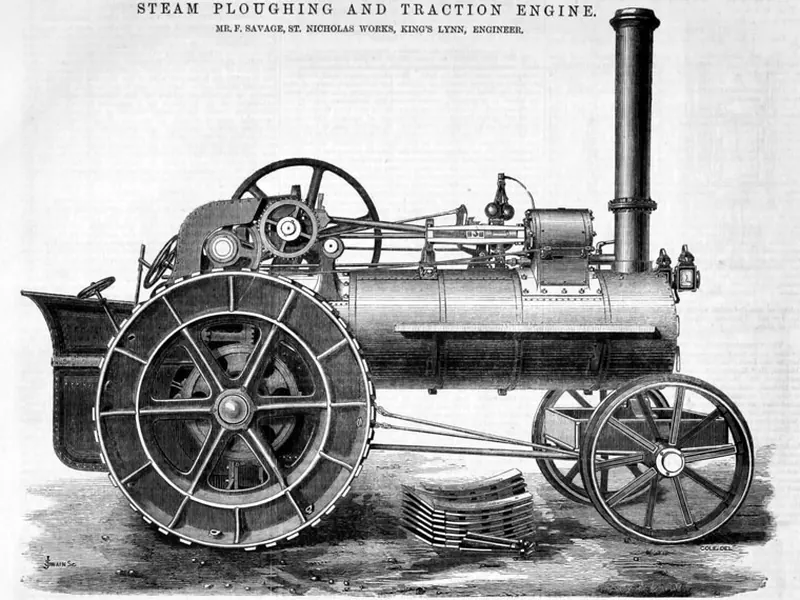
The diagrams on this site are our own, drawn from scratch and simplified so the moving parts are easy to follow (they are not to scale). The engravings, paintings and old photos are public domain, credited under each one and on the credits page.