Steam science without the steam
No kettles, no flames. Everything here runs on muscles, breath and a bit of maths. (Real steam is properly hot, which is why we leave it to the museums.)
1. The syringe squeeze
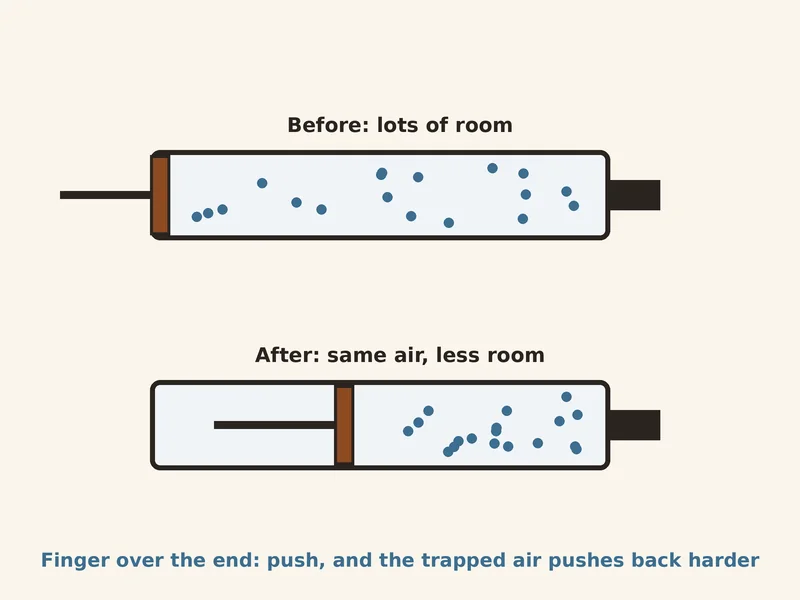
- Take a plastic syringe with no needle and pull the plunger halfway out.
- Put your finger firmly over the end.
- Push the plunger in. Feel it push back?
- Let go of the plunger and watch what it does.
In the mid-1600s Robert Boyle studied how the pressure and volume of a trapped gas are linked. NASA Glenn Research Center: Boyle’s law Boyle found that pressure times volume stays nearly constant: halve the space and the pressure goes up to match. NASA Glenn Research Center: Boyle’s law
NASA’s worked example: a gas filling 4.0 cubic metres at 1.0 kilopascal shrinks to 3.0 cubic metres when the pressure rises to 1.33 kilopascals. NASA Glenn Research Center: Boyle’s law
2. The card crank
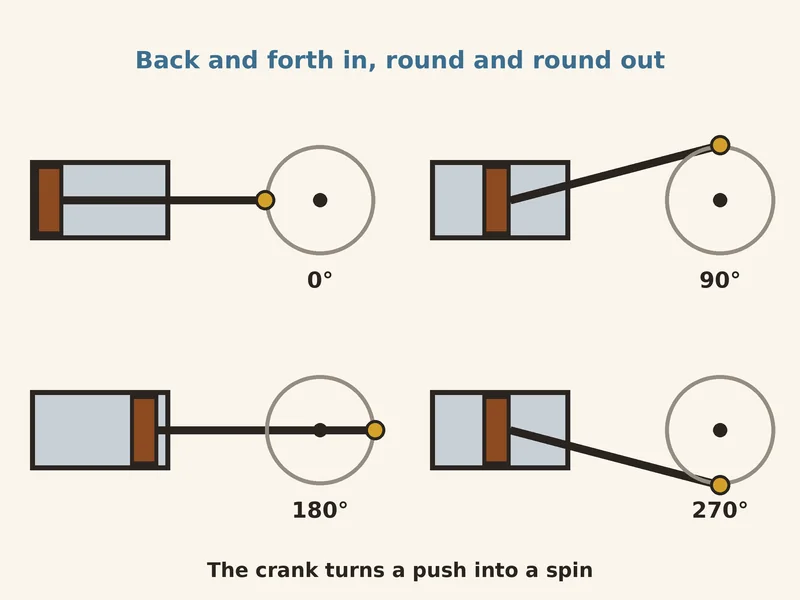
- Cut a circle of card and push a pencil through the middle for an axle.
- Make a hole near the edge and loosely fix one end of a paper strip there with a split pin.
- Slide the other end of the strip back and forth in a straight line.
- Watch the circle go round. That’s a crank.
In the classic engine the piston rod drives a crank on a flywheel, which turns the back-and-forth push into round-and-round motion. Encyclopaedia Britannica: steam engine
3. The flywheel test
- Make two card circles the same size, each with a pencil axle.
- Tape coins round the edge of one.
- Give each the same flick and time how long it spins.
- Which keeps going longer? Write it down.
A flywheel’s inertia resists changes in speed, smoothing out the jerky pushes of the piston. Encyclopaedia Britannica: flywheel Spin a flywheel twice as fast and it stores four times the energy. Encyclopaedia Britannica: flywheel
4. The balloon spinner
- Tape a bendy straw into the neck of a balloon, bent sideways.
- Push a pin through the top of the balloon into a pencil rubber, so it can turn.
- Blow it up through the straw, then let go.
- Air rushes out sideways and the balloon spins, a breath-powered cousin of Hero’s steam ball.
The aeolipile is a ball on a boiler with two angled nozzles: steam squirts out and the ball spins. Encyclopaedia Britannica: Heron of Alexandria
In a steam turbine, the steam rushes out of nozzles at high speed and spins the blades directly, with no piston at all. Encyclopaedia Britannica: steam engine
5. How many horsepower are you?
- Measure the height of a flight of stairs in feet.
- Time yourself walking (not racing) up it.
- Pop your weight in pounds, the height and the time into the calculator.
Physicists define work as force times the distance something moves. NASA Glenn Research Center: work Power is how fast work gets done: the rate of change of work over time. NASA Glenn Research Center: work
One horsepower is 33,000 foot-pounds of work a minute. Encyclopaedia Britannica: horsepower One horsepower is about 746 watts. Encyclopaedia Britannica: horsepower
The steps are our own wording; the facts beside them link to their sources. Ask a grown-up before borrowing coins, balloons or the stairs.
Next: the steam timeline →